
Infrastructure Financing by ICA Member Institutions
Institutions belonging to the Infrastructure Consortium for Africa (ICA) collectively committed US$77.9 billion to African infrastructure between 2021 and 2023. This made them the second-largest financing group after African national governments. The term “ICA members” refers to the consortium’s member institutions, not to African countries.
How member financing evolved
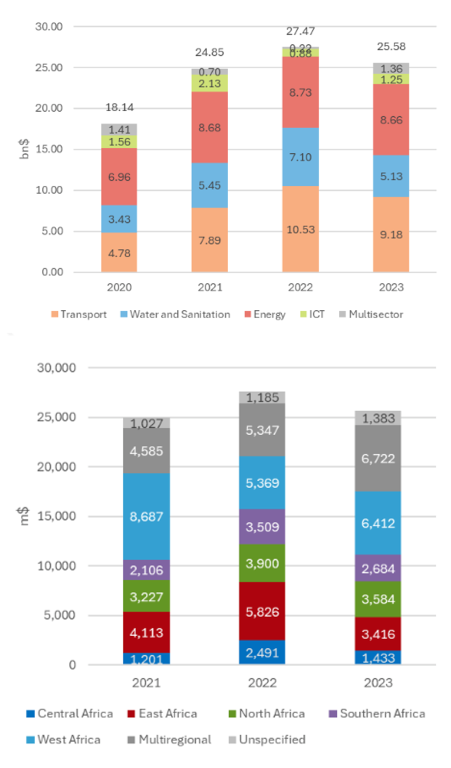
ICA member commitments increased from 2021 to 2022 before declining in 2023, partly reflecting changes in World Bank financing. Member institutions have different mandates and financing instruments; aggregate figures therefore conceal variation between individual financiers.
Financing priorities by sector
Energy attracted the largest share of ICA member financing initially, but transport overtook it in 2022, receiving US$10.5 billion that year. The two sectors account for much of the recorded support for connectivity and power infrastructure.
Where member financing went
West Africa received the most ICA member financing in 2021 (US$8.7 billion); East Africa led in 2022 (US$5.8 billion). In 2023, multiregional projects formed the largest identified category (US$6.7 billion). Some member commitments were not disaggregated geographically, limiting direct regional comparisons.
Country-specific commitments
Over 70% of ICA member commitments were directed to country-specific projects across the period. Nigeria received US$4.7 billion, followed by Egypt (US$4.6 billion), Senegal (US$4.0 billion), South Africa (US$3.3 billion) and Kenya (US$3.2 billion). These are commitments by ICA members, not total infrastructure financing received by each country.